Free · no sign-up · Epley & Brzycki
One rep max
calculator
Enter the reps and weight of one set: the calculator estimates your 1RM, the most you could lift for a single rep, and works out your training weights.
Pick the number of reps and enter the weight: your 1RM shows up here.
Estimated 1RM
kg
- Epley
- Brzycki
Your training weights
Based on your estimated 1RM, with the number of reps you can usually manage at each percentage.
| % of 1RM | Reps | Weight |
|---|---|---|
| Strength | ||
| 100% | 1 | — |
| 95% | 2 | — |
| 90% | 3–4 | — |
| 85% | 5–6 | — |
| Muscle growth | ||
| 80% | 7–8 | — |
| 75% | 9–10 | — |
| 70% | 11–12 | — |
| Muscular endurance | ||
| 65% | 13–15 | — |
| 60% | 16–20 | — |
| 55% | 21–25 | — |
| 50% | 26–30 | — |
Reps are a guide: they vary with the exercise and the person. Weights rounded to the nearest 0.5 kg or 1 lb.
What is a 1RM?
Your 1RM (one rep max) is the heaviest weight you can lift once on an exercise, with good form. Most strength programs are built on it: weights are given as a percentage of your 1RM, for example 5 sets of 5 reps at 80%.
Testing your true max is exhausting and risky, especially without experience. Working it out from a lighter set, taken to technical failure, gives an estimate that is good enough to set your training weights.
The Epley and Brzycki formulas
Two of the most widely used formulas to estimate a 1RM from a set of several reps.
Epley formula
1RM = weight × (1 + reps ÷ 30)
Proposed in 1985 by Boyd Epley, strength coach at the University of Nebraska. Below 10 reps, it gives a slightly higher result than Brzycki.
Brzycki formula
1RM = weight × 36 ÷ (37 − reps)
Published in 1993 by Matt Brzycki, of Princeton University. It is meant for sets of 10 reps or fewer; beyond that, it climbs faster than Epley.
Which value does the calculator use?
Both formulas give exactly the same result at 10 reps. Below that, Brzycki gives a little less than Epley; above it, the opposite. The calculator always uses the lower of the two: better to slightly underestimate your 1RM than to plan weights that are too heavy. With a single rep, the weight you lifted is your 1RM.
The limits of the calculation
An estimate, not a measurement
Your true max can be several kilos (or pounds) away. It depends on the exercise, your experience and how you feel that day.
Fewer reps, more accuracy
The calculation is more reliable with a heavy set of fewer than 10 reps, ideally 3 to 6. The longer the set, the more your endurance skews the result.
A set taken all the way
Enter a set you stopped when you couldn't do one more clean rep. A set stopped far from failure gives an underestimated 1RM.
Compound lifts
The formulas were built on compound exercises such as the squat, bench press and deadlift. On machines or isolation exercises, take the result with even more caution.
Be careful: never max out without a spotter
Don't go for your max alone. On the bench press and the squat, a spotter or safety bars are essential. Warm up gradually and stop as soon as your form breaks down: the calculator is here precisely so you don't have to take that risk.
Using your 1RM to make progress
The most common percentages of 1RM, depending on your goal.
Strength
85 to 100% · 1 to 6 reps
3 to 5 sets, 2 to 5 minutes of rest. Heavy weights, flawless form.
Muscle growth
70 to 85% · 6 to 12 reps
3 to 4 sets, 1 to 2 minutes of rest. The most common range in the gym.
Muscular endurance
50 to 65% · 13 reps or more
2 to 3 sets, 30 seconds to 1 minute of rest. Also handy for warm-up sets.
Recalculate every 4 to 8 weeks, or as soon as your sets feel easy: your weights keep up with your progress.
Track your weights, workout after workout
A free Keepifit account turns your phone into a gym log: you record your sets at the gym, and the app keeps everything and shows your progress.
-
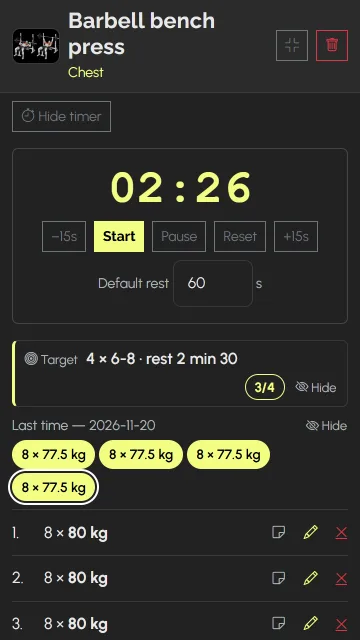
Your last weight, always in sight
During your workout, each exercise shows your sets from last time and your program's target. The next set is pre-filled, and the timer counts your rest.
-
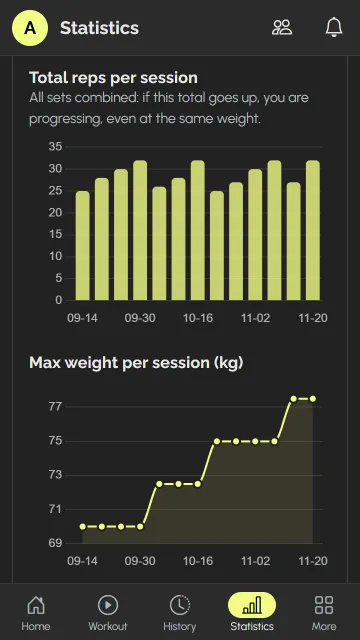
Your progress in charts
For each exercise, your total reps and max weight, session by session: you can see when to add weight.
-
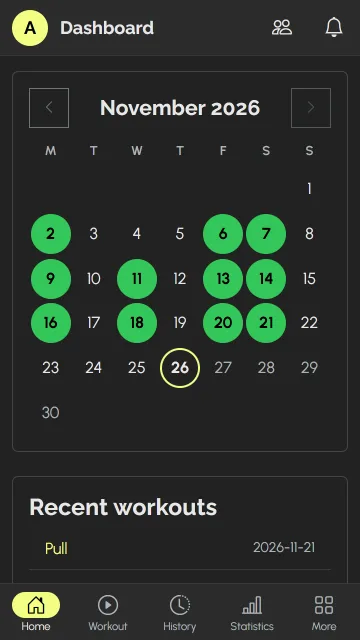
All your workouts in a calendar
A green dot for each training day: tap it to see the workout again, down to every set.
-
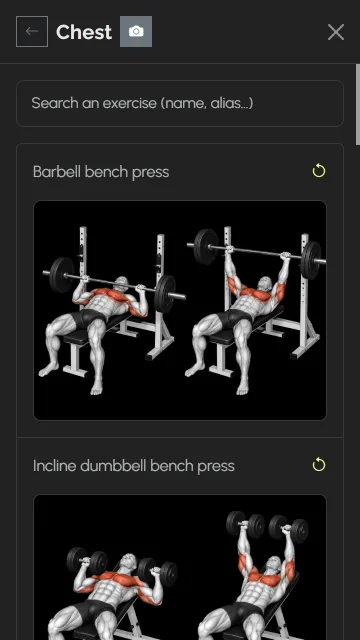
Illustrated exercises
Find an exercise by muscle group or by name, with an illustration of the movement and the muscles worked.
Free, no credit card needed.